

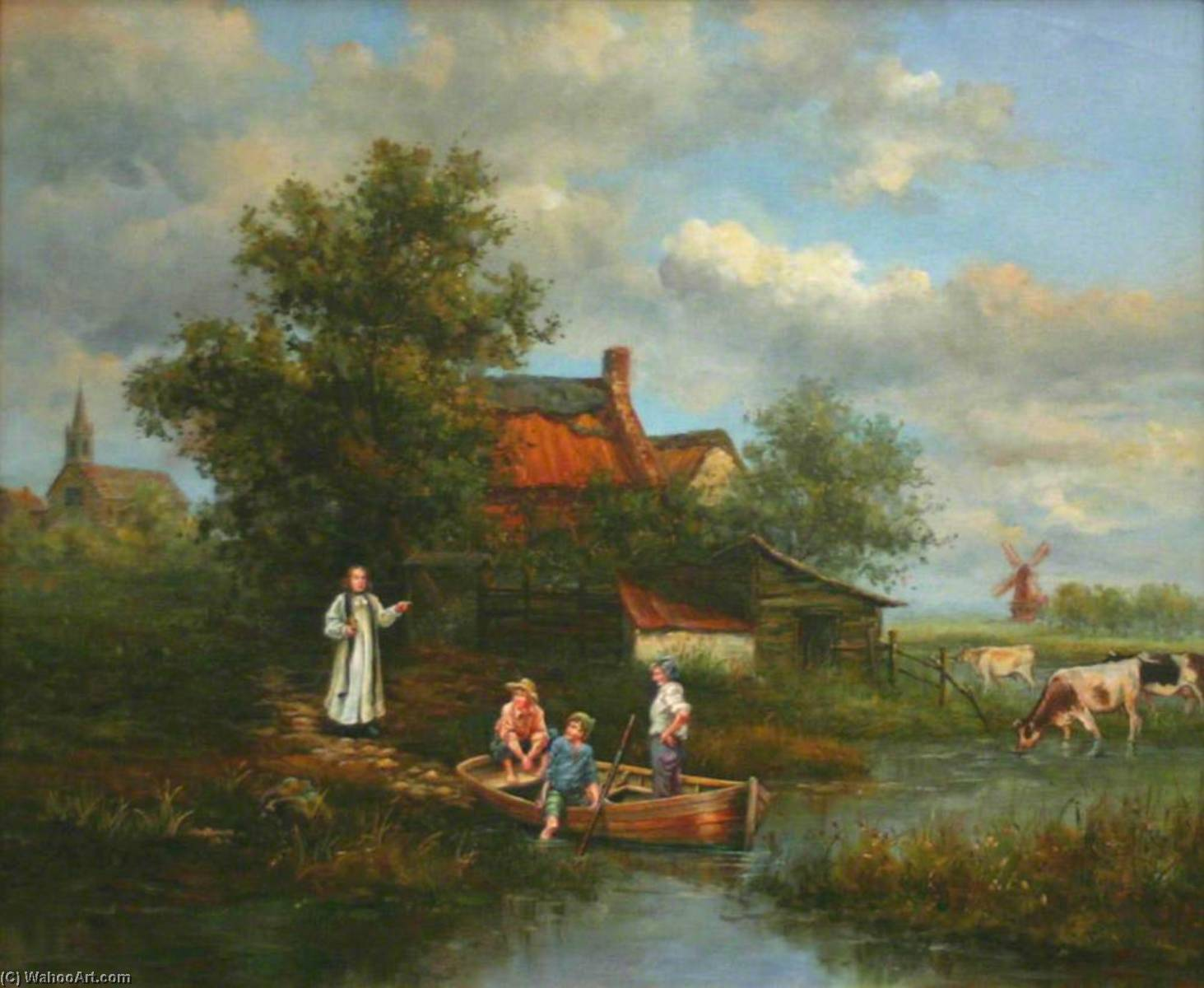
The above image is a depiction of John Wesley, founder of Methodism, at Wroot, Lincolnshire. It is an oil on canvas painting by artist Richard Gilmore Douglas. The life and ministry of John Wesley was centered around going outside of the walls of the church building and meeting people where they were…as depicted in this image.
Towards the end of Rev. Wesley’s ministry and life, he spent a considerable amount of time thinking about the new creation, and especially about “the full and physical resurrection of all creation.”1 Throughout Wesley’s writings, he draws our attention to the natural world, and he helps us understand how sin has wounded creation and has catastrophic effects on the natural world. In the end, Wesley helps us understand how there is a promise in the resurrection that all things will be made whole again (restoration).
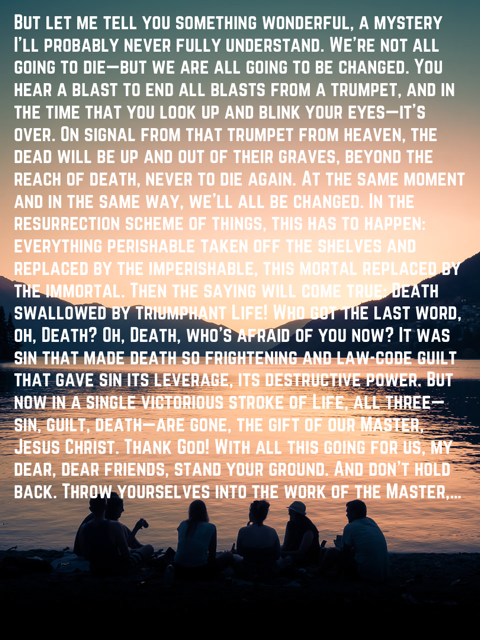
Matthew 15:51-58 [MSG]
John Wesley preached a message of a new creation that is both here and now as well as not yet. The new life has already begun through the life, death, and resurrection of Jesus Christ. As we look at the lives of those around us, we can see that the new creation is happening right here right now. As we are transformed through the grace of God we grow in love and holiness. The grace of God works in our lives as we work with God through this transformation – through this sanctifying and perfecting grace of God. As we look to Scripture, we find that we are all called to be ministers of reconciliation. We are called to works of mercy and justice as we engage in the missio dei (mission of God). This process is a transformation experience of love which brings about healing, mending, and restoration (reconciliation if you will) for all of creation. Put another way, as our relationship with God has been restored, we are called to this ministry of reconciliation. “All this is from God who reconciled us to himself through Christ and gave us the ministry of reconciliation…we are therefore Christ’s ambassadors, as though God were making an appeal through us” (2 Corinthians 5:18, 20). Paul does not stop there though, he continues by imploring us to open wide our hearts, allowing God’s compelling love to flow through us to others (2 Corinthians 5:14, 6:11).
Life in the 18th century was plagued with suffering, death, social unrest, and life spans which were much shorter than we experience today. The divide between those who were wealthy and those who had nothing was great – not unlike today. However, the wealth divide did not deter people of England from believing in a life after death. There were three options that were widely talked about: eternal life, eternal punishment, or eternal sleeping until the great day of judgement. These three beliefs did not stop the rising of people who believed that there absolutely was no afterlife – once dead, their existence stopped. For John Wesley, he believed that the new creation can be fully experienced right here and right now as we are changed from glory to glory. As Dr. Lobody states it, “through acts of love, in union with God’s loving work, we help bring about that new creation toward which we are ever leaning.”1
In John Wesley’s sermon, The General Deliverance, Sermon No. 60, Wesley opens his sermon by saying, “nothing is more sure, than that as ‘the Lord is loving to every man,’ so ‘his mercy is over all his work;’ all that have sense, all that are capable of pleasure or pain, of happiness or misery.”2 Wesley pauses to help us wrestle with questions that we certainly experience today. If God is so loving and merciful, why do we experience the calamities that plague us today? Wesley would say, “I hear you, I see you, I feel you…these are questions that have haunted philosophers and theologians alike throughout the centuries.” However Wesley then says, “it cannot be answered without having recourse to the oracles of God. But, taking these fo our guide we may inquire, 1. What was the original state of the brute creation, 2. In what state is it at present, And, 3. In what state will it be at the manifestation of the children of God?”3
In a helpful article by James E. Pedlar, we discover a take on John Wesley’s vision of new creation. He states, “For much of his life, John Wesley accepted common Christian assumptions regarding final salvation as a state of spiritual rest in paradise. Late in life, however, he rejected these assumptions, as ‘the new creation’ became a dominant theme in his theology. Wesley’s mature eschatological vision thus shifted from a hope for spiritual rest to a dynamic vision of redeemed humanity living in a transfonned, but still-physical new earth, complete with animal life.”4 John Wesley had a long heritage and thought process on the image of God – certainly thoughts that dated back to his early years which can be found in his sermon 141, The Image of God. On further examination, we discover that there is a direct connection between the image of God and humanity’s relationship to other creatures. Wesley’s three-fold understanding of the image of God is outlined in Sermon 45, The New Birth: “the natural image, which denotes those capacities which make humanity “capable of God,” including understanding, will, and liberty; the political image, which denotes humanity’s role as God’s vice-regents on earth, exercising leadership and management of creation as stewards; and the moral image, which is humanity’s vocation to imitate God in true righteousness and holiness.5
For a further deep dive of who John Wesley was, his mission, and his life, check out this youtube video: John Wesley: The Man and His Mission

References
1 Dr. Diane Lobody, Methodist Theological School of Ohio, course lecture and discussion post from Populi course materials. May 9, 2023.
2 “Wesley Center Online.” The Wesley Center Online: Sermon 60 – The General Deliverance. Accessed May 9, 2023. http://wesley.nnu.edu/john-wesley/the-sermons-of-john-wesley-1872-edition/sermon-60-the-general-deliverance/.
3 Ibid, ¶2.
4 Pedlar, James E. “‘His Mercy Is Over All His Works’: John Wesley’s Mature Vision of New Creation.” Canadian Theological Review 2, no. 2 (2013): 45–56.
5 (As noted by James Pedlar), “Wesley does not always speak of all three aspects of the image at once, but for an example of
a passage where he does do so,” see Sermon 45, “The New Birth,” §1.1 Works, 2: 188-89. His views on this subject are ably summarized in Runyon, The New Creation: John Wesley’s Theology Today, 13-19.
 jacobtipantasig-wolverton